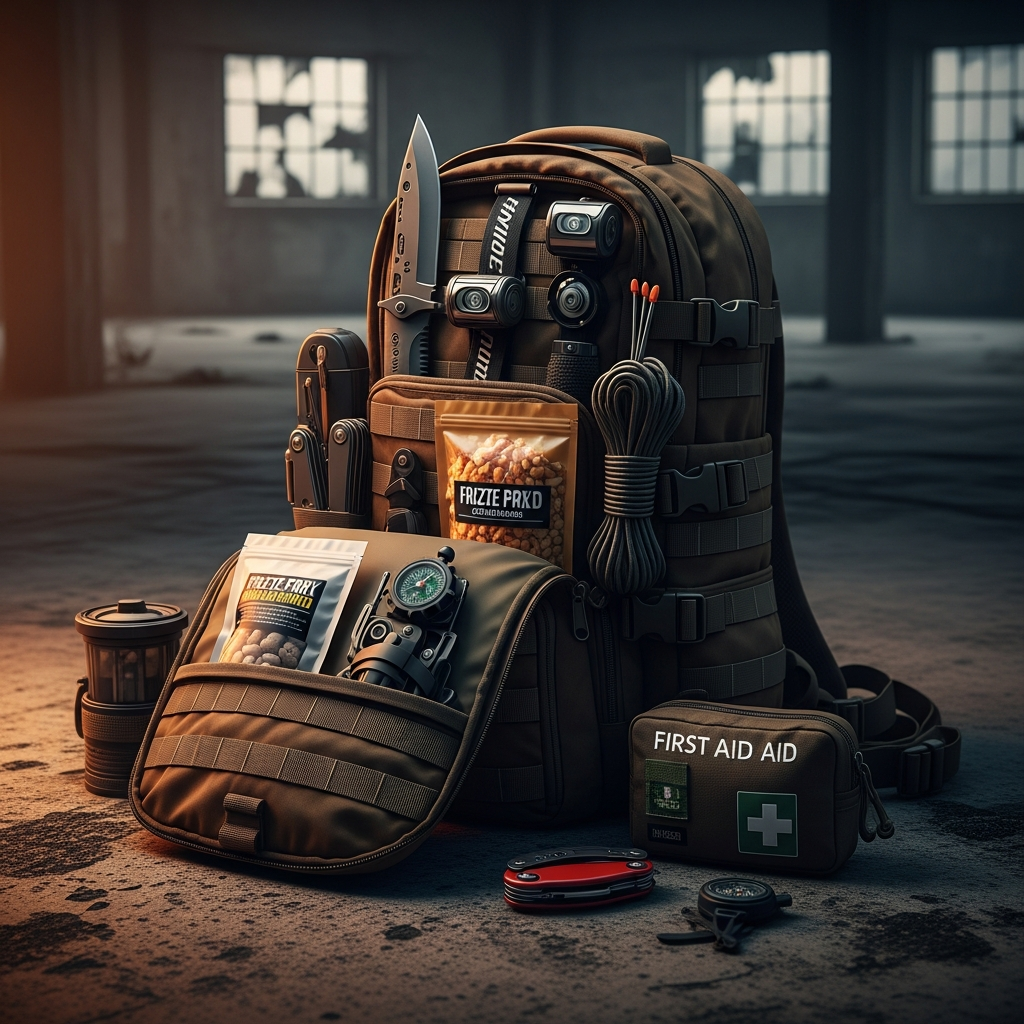
When SHTF, your tactical bag isn’t a backpack — it’s a lifeline. Day-X demands ruthless minimalism: water filter, fixed blade, fire, light, comms, trauma kit, calories. Pack what moves you forward, not what weighs you down. Train, repack, repeat — every week.
More tactical gear loadouts coming soon — this is your starting point.
Why Tactical Gear Matters
The Two Pillars: Carry & Illuminate
Every prepper’s loadout comes down to two foundations: a bag that lets you carry life-support for 72 hours, and a light that lets you operate when the world goes dark. Get these two right and 80% of your survival math is solved.
The 72-Hour Bag
Water, food, fire, shelter, comms, first aid — all on your back, ready to move. Get out the door in 30 seconds.
The Tactical Light
Grid-down navigation, search/identify, signal, deter. Modern lights make the difference between vulnerable and dominant.
Faraday Protection
Your radios, lights, and backup phone all need a shielded enclosure. EMP and CME events are real prep gaps.
The Big Comparison
Bug-Out Bag Tiers — Which Tier Are You?
Four bag tiers. Four very different prepper philosophies. Honest tradeoffs:
| Tier | EDC Sling | 24-Hr Pack | 72-Hr BOB | 7-Day INCH |
|---|---|---|---|---|
| Capacity | 5–15 L | 20–30 L | 40–60 L | 70–100+ L |
| Use Case | Daily carry | Get-Home Bag | Bug Out | I’m-Never-Coming-Home |
| Weight Loaded | 5–10 lb | 15–20 lb | 25–40 lb | 45–70 lb |
| Lives Where | On you | Car / office | By the door | Bug-out vehicle |
| Cost | $40–$150 | $80–$200 | $150–$400 | $300–$700 |
| SHTF Score | 6 / 10 | 8 / 10 | 10 / 10 | 9 / 10 |
🎯 The Verdict
The 72-Hour Bug-Out Bag is the universal starting point.
It’s sized for real evacuation scenarios, balances weight against capability, and works as the spine of the rest of your loadout. Build this first — everything else (EDC, GHB, INCH) becomes easier once you know what 72 hours of life-support actually weighs.
Tactical Light Performance Levels
Lumens, Candela, & Why It Matters
Don’t fall for the lumens marketing war. Throw distance (candela) is what separates EDC lights from real tactical use.
EDC Class (300–800 lm)
Pocket-friendly, USB-C rechargeable. Lights a hallway, identifies threats at 25 yards. Always-on you.
Best for: daily carry, household.
Tactical (1000–2000 lm)
Real throw (150–300 yd), strobe, tail-cap activation. The bug-out bag standard.
Best for: BOB, vehicle, home defense.
Search (2500–5000+ lm)
Floodlight territory, 21700 cells, runtime measured in hours. Search/rescue and serious off-grid.
Best for: search, recovery, perimeter.
Run a 3-light layered system: EDC on you, tactical in your BOB, search-class at home base. Single-light setups always fail. ↑ See the announcement boxes above to compare specific picks.
Don’t Make These Mistakes
Research note & sources
Our guidance is research-based and grounded in the published federal preparedness and measurement references below. We summarize the key facts in our own words and link to the original sources so you can verify them:
- The 72-hour standard behind a bug-out bag isn’t arbitrary — federal guidance recommends every household keep enough food, water and supplies to be self-sufficient for at least three days. Source: Ready.gov — Build A Kit.
- A lumen measures total light output while a candela measures intensity in one direction — which is why beam choice matters as much as raw lumens when picking a light. Source: NIST — Realization of the Lumen.
- Electromagnetic-pulse (EMP) protection through shielding — the principle behind a Faraday bag — is a recognized resilience measure for protecting electronics, per U.S. infrastructure-protection guidance. Source: CISA — Electromagnetic Pulse (EMP).
6 Common Tactical Gear Mistakes
❌ Mistake #1 — Buying tacticool instead of useful
If it looks military but you can’t fit a sleeping bag in it, it’s costume gear. Capacity, comfort, durability — in that order.
❌ Mistake #2 — Loading a bag you’ve never carried 5 miles
A 40-lb pack feels different at mile 4. Do a real ruck. Half the gear comes out by the time you’re home.
❌ Mistake #3 — One flashlight, one set of batteries
Lights fail. Batteries die. Always carry a backup light + 2 sets of cells (rechargeable + lithium primaries).
❌ Mistake #4 — No medical kit in the bag
A tourniquet, chest seals, and trauma pack weigh 1 lb. Every BOB needs them. Adventure first aid kits don’t count for SHTF trauma.
❌ Mistake #5 — Skipping the Faraday bag
EMP / CME / solar storms are not theoretical. A $40 Faraday sleeve protects your backup radios, lights, and burner phone for life.
❌ Mistake #6 — Treating it like a finished project
Rotate food/water/batteries every 6 months. Re-pack seasonally. The bag that sat untouched for 3 years is full of dead gear.
Build Both Pillars
Two Reviews. One Loadout.
The bag carries the kit. The light operates the kit when the sun goes down. Build both reviews into one balanced loadout — head to the matching comparison pages above to see how the picks rank head-to-head.