
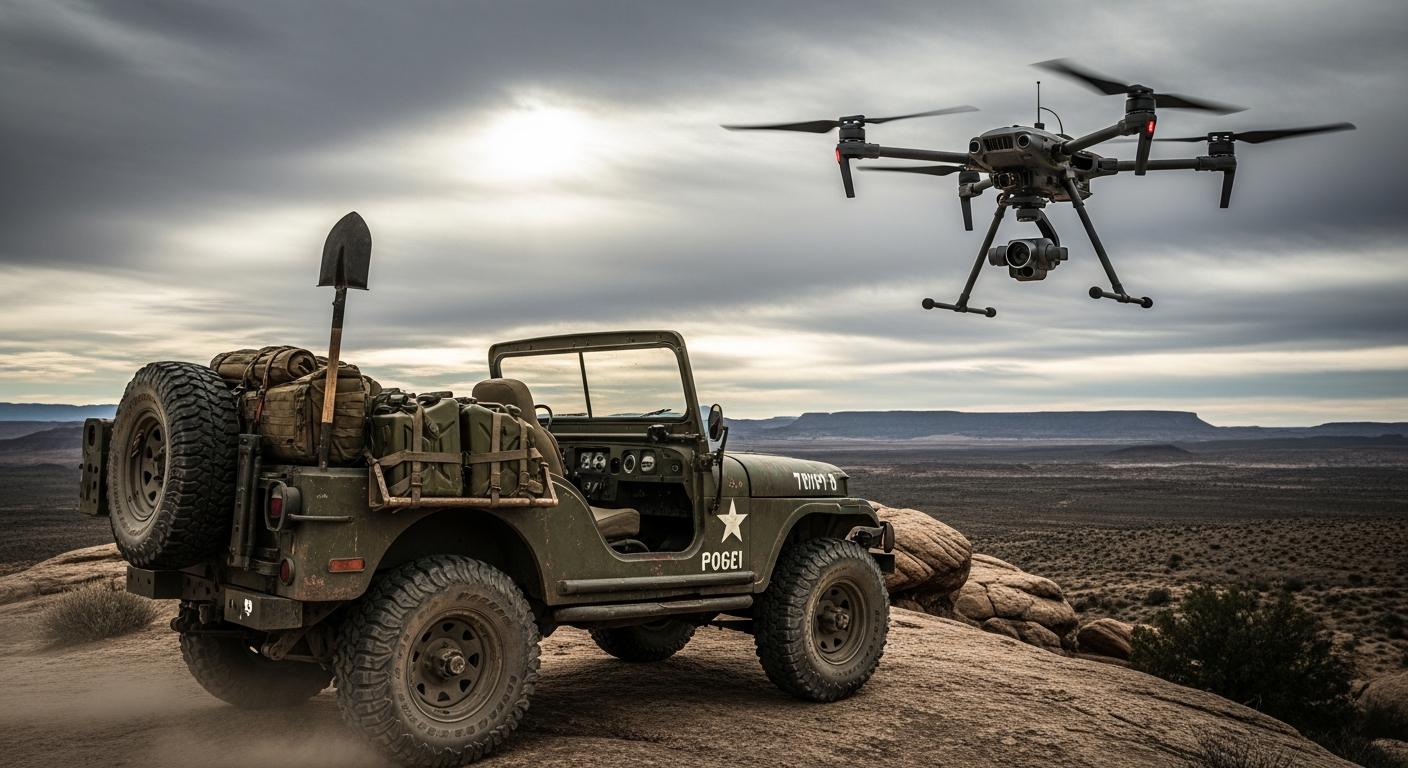
Owning a tactical drone is step one. Knowing how to use it for route recon before your bug-out vehicle convoy moves — that’s the skill that keeps your family alive. This guide gives you the step-by-step protocol for running effective drone recon before, during, and after a bug-out run.
Why Route Recon Matters
In a grid-down scenario, roads are unpredictable. Bridges wash out. Checkpoints form. Crowds block intersections. Hostile groups control chokepoints. Driving blind into any of these in a loaded bug-out rig can be fatal. A drone eliminates that blind spot — giving you the same advantage military units use: eyes ahead of every move, before every commitment.
This only works if you’re running your drone over the route before your vehicle reaches that section, not as you’re driving through it. Timing is everything.
Pre-Launch Checklist
- Battery at 100% — always launch with full power
- Spare battery at 80%+ charged and ready to swap
- GMRS radio on and scanning — your ground team needs to act on what you see in real time
- Route segment plotted: know exactly which stretch of road you’re scouting
- Return-to-home altitude set to 60m+ — clears most obstacles in rural terrain
- Video recording ON before takeoff — review footage after landing, not during flight
The 3-Phase Recon Protocol
Phase 1 — Altitude Overview (200–300ft): Launch to altitude and fly the route at speed. You’re scanning for anomalies: crowd gatherings, smoke, vehicle clusters, roadblocks, washed-out sections. Mark any GPS coordinates that flag and move to Phase 2.
Phase 2 — Close Investigation (50–100ft): Drop altitude on anything that flagged. Use optical zoom to identify people and assess threat level at a safe distance. Can you identify weapons? Uniforms? Vehicle types? Count headcount. Report findings to ground team on GMRS radio.
Phase 3 — Route Decision: Based on recon you have three options: proceed (route clear), divert (known alternative), or hold until the situation changes. Never commit your bug-out vehicle to a route segment you haven’t personally cleared with eyes from altitude.
What to Look For
- Road conditions: washouts, downed trees, debris fields, flooded sections
- Chokepoints: narrow bridges, underpasses, single-lane sections with no bypass
- Human activity: crowds, checkpoints (official or otherwise), vehicles blocking lanes
- Infrastructure: downed power lines across road, structural damage to bridges
- Smoke and fire: direction of spread tells you which routes to avoid or exploit
Battery Management on the Move
A single battery gives you 30–46 minutes of flight. For a typical bug-out run, scout 5–10 miles ahead at a time. That requires rotating batteries every 2–3 route segments. Carry a minimum of three batteries and a multi-battery charging hub. If stopped at a position for 45+ minutes, charge while you wait. For off-grid charging during extended operations, read our guide on keeping your drone running without grid power.
Communication Protocol
Recon data is worthless if it doesn’t reach your team in time to act. Establish clear radio protocol before you ever launch: GMRS radios on a dedicated channel, brevity codes for common observations (CLEAR, BLOCK, THREAT, DIVERT), and always call findings before landing — not after. The 30 seconds you spend circling for a better look is 30 seconds your convoy could be moving.
Practice Now — Not on Day-X
Run this protocol on your actual bug-out route before you ever need it. Drive the route, fly the drone, practice the communication protocol. The best drone you can buy is worthless if you crash it on the first sortie because you never practiced. Fly every weekend. Know its battery drain curve. Know exactly how far it reaches and still returns. That knowledge, built now, is what keeps your bug-out vehicle and your family moving safely when it matters.
RELATED GUIDES
Complete Your Drone Recon Setup
“First… Prepare with Knowledge!”